Showing posts with label Todays Wiki Article. Show all posts

2026/04/14

Steve Shirley


Steve Shirley

From Wikipedia, the free encyclopedia

Stephanie Shirley
Shirley in 2013
Born
Vera Buchthal [1]

16 September 1933
Died9 August 2025 (aged 91)
Reading, England
Other namesVera Stephanie Buchthal
Stephanie Brook
OccupationsBusinesswoman and philanthropist
Organisations
FatherArnold Buchthal
RelativesRosa Buchthal (grandmother)
AwardsFREng (2001)
CHM Fellow (2018)
Honours
Websitesteveshirley.com

Dame Vera Stephanie Shirley (previously Brook, née Buchthal; 16 September 1933 – 9 August 2025) was a German-born British information technology pioneer, businesswoman and philanthropist.[2][3]

Life and career

Shirley was born Vera Buchthal to Arnold Buchthal, a judge in Dortmund who was Jewish and who lost his post to the Nazi regime,[4] and Margaret (née Schick), a non-Jewish Viennese mother.[5] Her paternal grandmother was politician and women's rightsactivist Rosa Buchthal.[6] In July 1939, at the age of five, Shirley and her nine-year-old sister Renate travelled to Britain as Kindertransport child refugees.[4][1]

She was fostered by parents in Sutton Coldfield.[7] She was later re-united with her biological parents, but said she "never really bonded with them".[8] Shirley attributed her early childhood trauma as being the driving force behind her ability to keep up with changes in her life and career.[citation needed]

After attending a convent school, she moved to Oswestry where she attended the Oswestry Girls' High School. Mathematics was not taught at the school, so she received permission after assessment to take those lessons at the local boys school. She would later recall that, after her Kindertransport and wartime experiences, "in Oswestry I had five wonderful years of peace".[7]

After leaving school, Shirley decided not to go to university (botany was the "only science then available to my gender") but sought employment in a mathematics/technical environment.[9] At the age of 18, she became a British citizen and changed her name to Stephanie Brook.[9]

In the 1950s, she worked at the Post Office Research Station at Dollis Hill, building computers from scratch and writing code in machine language.[10] She took evening classes for six years to obtain an honours degree in mathematics. In 1959, she moved to CDL Ltd, designers of the ICT 1301 computer.

After her marriage to physicist Derek Shirley in 1959,[11] Shirley founded the software company Freelance Programmers with a capital of £6.[4] Having experienced sexismin her workplace, "being fondled, being pushed against the wall",[12] she wanted to create job opportunities for women with dependents, and predominantly employed women, with only three male programmers in the first 300 staff,[13] until the Sex Discrimination Act 1975 made that practice illegal. The company was also innovative in that its employees worked part time and from home, so that they could better juggle family responsibilities; Shirley regarded the company as a social endeavor as well as a business.[14] She also adopted the name "Steve" to help her in the male-dominated business world,[15][12] given that company letters signed using her real name were not responded to.[16] Her team's projects included programming Concorde's black box flight recorder.[7][17]

She served as an independent non-executive director for Tandem Computers Inc., the Atomic Energy Authority (later AEA Technology) and the John Lewis Partnership.

Shirley retired in 1993 at the age of 60, and focused on philanthropy.[5] She died aged 91 in a nursing home in Reading, England, on 9 August 2025.[18][19][20]

Philanthropy

The Shirley Foundation, based in the UK, was set up by Shirley in 1986 with a substantial gift to establish a charitable trust fund which spent out in 2018 in favour of Autistica. Its mission was facilitation and support of pioneering projects with strategic impact in the field of autism spectrum disorders with particular emphasis on medical research. The fund has supported many projects through grants and loans including: Autism at Kingwood which supports people with autism spectrum disorders to enjoy full and active lives; Prior's Court, the foundation's largest benefaction, with a residential school for 70 autistic pupils and Young Adult Centre for 20 autistic students; Autism99, the first online autism conference attended by 165,000 people from 33 countries. She addressed conferences around the world (many remotely) and was in frequent contact with parents, carers and those with autism spectrum disorders.[21] Her autistic son Giles died following an epileptic seizure at the age of 35.[22]

From May 2009 until May 2010, Shirley served as the UK's Ambassador for Philanthropy, a government appointment aimed at giving philanthropists a "voice".[23][24]

In 2012, Shirley donated the entirety of her art collection, including works by Elisabeth FrinkMaggi HamblingThomas HeatherwickJosef Herman and John Piper to Prior's Court School and the charity Paintings in Hospitals.[25]

In 2013, appearing on BBC Radio 2's Good Morning Sunday with Clare Balding, Shirley discussed why she had given away more than £67 million of her personal wealth to different projects. In her 2012 memoirs Let IT Go, she writes "I do it because of my personal history; I need to justify the fact that my life was saved".[22]

Honours and legacy

Shirley received her BSc in 1956 and was appointed Officer of the Order of the British Empire (OBE) in the 1980 Birthday Honours[26]for services to industry; Dame Commander of the Order of the British Empire (DBE) in the 2000 New Year Honours for services to information technology.;[27] and Member of the Order of the Companions of Honour (CH) in the 2017 Birthday Honours for services to the IT industry and philanthropy.[28]

In 1987, she gained the Freedom of the City of London. She was the first female President of the chartered British Computer Societyfrom 1989 to 1990 and Master of the IT livery company 1992/93.[29] In 1985, she was awarded a Recognition of Information Technology Award. In 1999, she received the Mountbatten Medal.[30]

She was appointed a Fellow of the Royal Academy of Engineering and of Birkbeck College in 2001.[31][32] In 2002 she was elected as Honorary Fellow at Murray Edwards CollegeUniversity of Cambridge. At a ceremony at the Dome, Brighton East Sussex on April 25th, 2009, Dame Stephanie was awarded an Honary Doctorate by the Open University

She donated most of her wealth (from the internal sale to the company staff and later the flotation of FI Group) to charity.[33][34]Beneficiaries include the Worshipful Company of Information Technologists and the Oxford Internet Institute, part of the Oxford University, through the Shirley Foundation. Her late son Giles (1963–1998) was autistic and she became an early member of the National Autistic Society.[35] Via the charity Autistica she instigated and funded research in this field.[citation needed]

In 2003, Shirley received the Beacon Fellowship Prize for her contribution to autism research and for her pioneering work in harnessing information technology for the public good.[36]

In 1991, Shirley was awarded an honorary doctorate from the University of Buckingham; later she was honoured by the University of Cambridge, and in 2022 by the University of Kent and 28 other UK Universities.[37][38]

In February 2013, she was assessed as one of the 100 most powerful women in the United Kingdom by Woman's Hour on BBC Radio 4.[39] She was also recognized as one of the BBC's 100 women of 2013.[40]

In January 2014, the Science Council named Shirley as one of the "Top 100 practising scientists" in the UK.[41]

In 2018, she was made a Fellow of the Computer History Museum,[42] and became the first woman to win the Gold Medal of the Chartered Management Institute 'for her stellar contribution to British engineering and technology'.[43]

In August 2021, Shirley unveiled a blue plaque in Oswestry commemorating her school years in the town, the plaque is located on The Broadwalk close to St Oswald's Parish Church.[44]

In September 2021 Shirley unveiled a statue by Ian Wolter on Harwich Quay, Essex. It commemorates the arrival of the Kindertransport children at the port.[45]

2025/12/31

Todays Wiki Article: Assembly Theory

Assembly theory

 For the communication theory about social interactions, see action assembly theory.

Synthesis of aristolochic acid. Complex molecules require many steps to be synthesized. And the more steps are required to synthesize a particular molecule, the more likely it is of a biological (or technological) origin.

Assembly theory is a framework developed to quantify the complexity of molecules and objects by assessing the minimal number of steps required to assemble them from fundamental building blocks. Proposed by chemist Lee Cronin and his team, the theory assigns an assembly index to molecules, which serves as a measurable indicator of their structural complexity. Cronin and colleagues argue that this approach allows for experimental verification and has applications in understanding selection processes, evolution, and the identification of biosignatures in astrobiology.[1] However, the usefulness of the approach has been disputed.

Background

The hypothesis was proposed by chemist Leroy Cronin in 2017 and developed by the team he leads at the University of Glasgow,[2][3] then extended in collaboration with a team at Arizona State University led by astrobiologist Sara Imari Walker, in a paper released in 2021.[4]

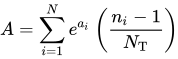
Assembly theory conceptualizes objects not as point particles, but as entities defined by their possible formation histories.[5] This allows objects to show evidence of selection, within well-defined boundaries of individuals or selected units.[5] Combinatorial objects are important in chemistry, biology and technology, in which most objects of interest (if not all) are hierarchical modular structures.[5]For any object an 'assembly space' can be defined as all recursively assembled pathways that produce this object.[5] The 'assembly index' is the number of steps on a shortest path producing the object.[5] For such shortest path, the assembly space captures the minimal memory, in terms of the minimal number of operations necessary to construct an object based on objects that could have existed in its past.[5] The assembly is defined as "the total amount of selection necessary to produce an ensemble of observed objects"; for an ensemble containing  objects in total,  of which are unique, the assembly  is defined to be

,

where  denotes 'copy number', the number of occurrences of objects of type  having assembly index .[5]

For example, the word 'abracadabra' contains 5 unique letters (a, b, c, d and r) and is 11 symbols long. It can be assembled from its constituents as a + b --> ab + r --> abr + a --> abra + c --> abrac + a --> abraca + d --> abracad + abra --> abracadabra, because 'abra' was already constructed at an earlier stage. Because this requires at least 7 steps, the assembly index is 7.[6] The word 'abracadrbaa', of the same length, for example, has no repeats so has an assembly index of 10.

Take two binary strings  and  as another example. Both have the same length  bits, both have the same Hamming weight . However, the assembly index of the first string is  ("01" is assembled, joined with itself into "0101", and joined again with "0101" taken from the assembly pool), while the assembly index of the second string is , since in this case only "01" can be taken from the assembly pool.[citation needed]

In general, for K subunits of an object O the assembly index is bounded by .[3]

Once a pathway to assemble an object is discovered, the object can be reproduced. The rate of discovery of new objects can be defined by the expansion rate , introducing a discovery timescale .[5] To include copy number  in the dynamics of assembly theory, a production timescale  is defined, where  is the production rate of a specific object .[5] Defining these two distinct timescales , for the initial discovery of an object, and , for making copies of existing objects, allows to determine the regimes in which selection is possible.[5]

While other approaches can provide a measure of complexity, the researchers claim that assembly theory's molecular assembly number is the first to be measurable experimentally. Molecules with a high assembly index are very unlikely to form abiotically, and the probability of abiotic formation goes down as the value of the assembly index increases.[5] The assembly index of a molecule can be obtained directly via spectroscopic methods.[5][1] This method could be implemented in a fragmentation tandem mass spectrometry instrument to search for biosignatures.[1]

The theory was extended to map chemical space with molecular assembly trees, demonstrating the application of this approach in drug discovery,[2] in particular in research of new opiate-like molecules by connecting the "assembly pool elements through the same pattern in which they were disconnected from their parent compound(s)". 

It is difficult to identify chemical signatures that are unique to life.[7] For example, the Viking lander biological experiments detected molecules that could be explained by either living or natural non-living processes.[8] It appears that only living samples can produce assembly index measurements above ~15.[1] However, 2021, Cronin first explained how polyoxometalates could have large assembly indexes >15 in theory due to autocatalysis.[9]

Critical views

Chemist Steven A. Benner has publicly criticized various aspects of assembly theory.[10] Benner argues that it is transparently false that non-living systems, and with no life intervention, cannot contain molecules that are complex but people would be misled in thinking that because it was published in Nature journals after peer review, these papers must be right.

A paper published in the Journal of Molecular Evolution[11] concludes that "the hype around Assembly Theory reflects rather unfavorably both on the authors and the scientific publication system in general". The author[11] concludes that what "assembly theory really does is to detect and quantify bias caused by higher-level constraints in some well-defined rule-based worlds"; one "can use assembly theory to check whether something unexpected is going on in a very broad range of computational model worlds or universes".

Another paper authored by a group of chemists and planetary scientists published in the Journal of the Royal Society Interface[12]demonstrated that abiotic chemical processes have the potential to form crystal structures of great complexity — values exceeding the proposed abiotic/biotic divide of MA index = 15. They conclude that "while the proposal of a biosignature based on a molecular assembly index of 15 is an intriguing and testable concept, the contention that only life can generate molecular structures with MA index ≥ 15 is in error".

Two papers published in 2024 argue that assembly theory provides no insights beyond those already available using algorithmic complexity and Claude Shannon's information theory.[13][14]

See also

References

  1.  Marshall SM, Mathis C, Carrick E, et al. (24 May 2021). "Identifying molecules as biosignatures with assembly theory and mass spectrometry"Nature Communications12 (3033): 3033. Bibcode:2021NatCo..12.3033Mdoi:10.1038/s41467-021-23258-xPMC 8144626PMID 34031398.
  2.  Liu, Yu; Mathis, Cole; Bajczyk, Michał Dariusz; Marshall, Stuart M.; Wilbraham, Liam; Cronin, Leroy (2021). "Exploring and mapping chemical space with molecular assembly trees"Science Advances7 (39) eabj2465. Bibcode:2021SciA....7J2465Ldoi:10.1126/sciadv.abj2465PMC 8462901PMID 34559562.
  3.  Marshall, Stuart M.; Murray, Alastair R. G.; Cronin, Leroy (2017). "A probabilistic framework for identifying biosignatures using Pathway Complexity"Philosophical Transactions of the Royal Society A: Mathematical, Physical and Engineering Sciences375 (2109). arXiv:1705.03460Bibcode:2017RSPTA.37560342Mdoi:10.1098/rsta.2016.0342PMC 5686400PMID 29133442.
  4.  Sara Imari Walker; Leroy Cronin; Alexa Drew; Shawn Domagal-Goldman; Theresa Fisher; Michael Line; Camerian Millsaps (7 April 2019). "Probabilistic Biosignature Frameworks". In Victoria Meadows; Giada Arney; Britney Schmidt; David J. Des Marais (eds.). Planetary Astrobiologydoi:10.2458/azu_uapress_9780816540068-ch018.
  5.  Sharma, Abhishek; Czégel, Dániel; Lachmann, Michael; Kempes, Christopher P.; Walker, Sara I.; Cronin, Leroy (October 2023). "Assembly theory explains and quantifies selection and evolution"Nature622 (7982): 321–328. Bibcode:2023Natur.622..321Sdoi:10.1038/s41586-023-06600-9ISSN 1476-4687PMC 10567559PMID 37794189.
  6.  Mathis, Cole; Y. Patarroyo, Keith; Cronin, Lee. "Understanding Assembly Indices"Molecular Assembly. Cronin Group. Retrieved 26 March 2024resulting in an Assembly Index of 7
  7.  Schwieterman, Edward W.; Kiang, Nancy Y.; Parenteau, Mary N.; Harman, Chester E.; Dassarma, Shiladitya; Fisher, Theresa M.; Arney, Giada N.; Hartnett, Hilairy E.; Reinhard, Christopher T.; Olson, Stephanie L.; Meadows, Victoria S.; Cockell, Charles S.; Walker, Sara I.; Grenfell, John Lee; Hegde, Siddharth; Rugheimer, Sarah; Hu, Renyu; Lyons, Timothy W. (2018). "Exoplanet Biosignatures: A Review of Remotely Detectable Signs of Life"Astrobiology18 (6): 663–708. arXiv:1705.05791Bibcode:2018AsBio..18..663Sdoi:10.1089/ast.2017.1729PMC 6016574PMID 29727196.
  8.  Plaxco KW, Gross M (12 August 2011). Astrobiology: A Brief Introduction. JHU Press. pp. 285–286. ISBN 978-1-4214-0194-2. Retrieved 16 July 2013.
  9.  Cronin, Leroy (2021). "Exploring the Hidden Constraints that Control the Self-Assembly of Nanomolecular Inorganic Clusters"Bulletin of Japan Society of Coordination Chemistry7811–17. doi:10.4019/bjscc.78.11.
  10.  Benner, Steven A. "Assembly Theory and Agnostic Life Finding – The Primordial Scoop". Retrieved 19 September 2023.
  11.  Jaeger, Johannes (2024). "Assembly Theory: What It Does and What It Does Not Do"Journal of Molecular Evolution92(2): 87–92. Bibcode:2024JMolE..92...87Jdoi:10.1007/s00239-024-10163-2PMC 10978598PMID 38453740.
  12.  Hazen, Robert M.; Burns, Peter C.; Cleaves II, H. James; Downs, Robert T.; Krivovichev, Sergey V.; Wong, Michael L. (2024). "Molecular assembly indices of mineral heteropolyanions: some abiotic molecules are as complex as large biomolecules"Journal of the Royal Society Interface21 (211). Bibcode:2024JRSI...2130632Hdoi:10.1098/rsif.2023.0632PMC 10878807PMID 38378136.
  13.  Uthamacumaran, A.; Abrahão, F. S.; Kiani, N. A.; et al. (7 August 2024). "On the salient limitations of the methods of assembly theory and their classification of molecular biosignatures"npj Systems Biology and Applications10 (1): 82. arXiv:2210.00901doi:10.1038/s41540-024-00403-yPMC 11306634PMID 39112510.
  14.  Abrahão, F. S.; Hernández-Orozco, S.; Kiani, N. A.; Tegnér, J.; Zenil, H. (23 September 2024). "Assembly Theory is an approximation to algorithmic complexity based on LZ compression that does not explain selection or evolution"PLOS Complex Systems1 e0000014. arXiv:2403.06629doi:10.1371/journal.pcsy.0000014.

Further reading

Todays Thought

 Once you've accepted your flaws, no one can use them against you. -George R.R. Martin